
How long does it actually take for diet changes to affect egg quality?

If you are trying to conceive, preparing for IVF, or considering egg freezing, there is a reasonable chance you have already started thinking about what you eat. And somewhere in that process, you have probably wondered: does any of this actually make a difference? And if so, how long does it take?
These are good questions, and they deserve a straight answer, not a vague "every body is different" non-response (although that is also true!).
So here is what the research actually tells us about diet, egg quality, and timing.
First, a quick note on how eggs actually develop
Eggs do not appear overnight. Each one goes through a long maturation process inside the ovary, and research suggests that a primordial follicle (the very earliest stage) takes close to a year to fully mature and ovulate.
The most important window, though, is the final three to four months before ovulation. This is when the egg grows rapidly, accumulates nutrients, and prepares for possible fertilisation. It’s during this period that the follicular environment, including what nutrients are available, has the most direct influence on egg development.
In practical terms, this is where the often-cited "90-day rule" comes from. If you want your dietary changes to have a meaningful chance of influencing the eggs that will ovulate in the near future, you are working with a lead time of roughly three months.
What can nutrition actually influence in that window?
To be clear about what we are talking about: nutrition cannot reverse age-related egg quality decline or override genetic factors. These are biological realities, and anyone suggesting otherwise is overpromising.
What nutrition can do is support the environment in which eggs are maturing. Research points to a few specific mechanisms:
Oxidative stress: Eggs are sensitive to damage from reactive oxygen species – essentially, cellular stress. Diets rich in antioxidants (found in vegetables, fruits, nuts, and fatty fish) may help reduce this oxidative load in the ovarian environment. Studies looking at follicular fluid, the fluid directly surrounding developing eggs, have found that higher levels of oxidative stress markers correlate with poorer egg quality and fertilisation rates.
Insulin and blood sugar regulation: Elevated insulin levels can disrupt the ovarian environment, particularly in people with PCOS, but emerging research suggests, potentially also in those without it. One 2021 study found that insulin-resistant women without PCOS had lower proportions of mature eggs and viable blastocysts in IVF compared to those with normal insulin sensitivity.
Nutrient availability: Certain micronutrients like folate, vitamin D, omega-3 fatty acids, and CoQ10 are thought to support egg development, DNA replication, and cellular energy production in maturing eggs. Deficiencies in these nutrients are common and correcting them is one of the more straightforward things within your control.
Want the full picture on nutrients, supplements, and what is genuinely worth your attention?
The Food & Fertility: Egg Cell Quality Guide covers the evidence on key nutrients, supplement considerations, bloodwork interpretation, and how to eat in a way that actually supports egg health, without the overwhelm.

Does this mean last-minute changes are pointless?
Not entirely. But the honest answer is that changes made in the final few weeks before an egg retrieval or IVF cycle are unlikely to have much impact on the eggs already mid-way through development.
This is actually useful information, even if it is not what people always want to hear. It means the time to focus on nutrition is before you are deep into a cycle. Ideally, in the three months leading up to it. It also means that if you have already been eating well for a while, you can trust that work.
And for those who are still a few months out from starting treatment, or who are trying to conceive naturally: you are in the window where consistent dietary habits can genuinely make a difference to the eggs that are developing right now.
What does "eating well for egg quality" actually look like?
The research does not support any single fertility superfood or a highly restrictive diet. What it does support, consistently, is a dietary pattern that is:
Rich in vegetables, legumes, and whole grains, which provide fibre, folate, and antioxidant compounds.
Inclusive of quality protein across both animal and plant sources.
Built around anti-inflammatory fats like olive oil, fatty fish, nuts, seeds, rather than heavily processed fats.
Adequate in key micronutrients, including folate, vitamin D, and iron, which are worth checking via bloodwork if you have not already.
This is not a radical overhaul. For most people, it is a matter of building consistency with a handful of habits rather than starting from scratch.
It is also worth saying: eating under significant stress or turning nutrition into another source of anxiety on an already difficult journey, is counterproductive. The goal is to support your body, not to add more pressure to a process that already has enough of it.
A word on supplements
Supplements come up constantly in conversations about egg quality and some of them do have reasonably good evidence behind them. Coenzyme Q10 (CoQ10), for example, has been studied for its role in cellular energy production in eggs, and folic acid is unequivocally important for DNA replication. Vitamin D deficiency is worth correcting if your levels are low.
But the supplement space also has a lot of noise. Products marketed specifically as "egg quality" supplements are not regulated the same way as medications, and the evidence behind many of them is limited or mixed. Before spending money on a long list of capsules, it’s worth understanding which ones actually have clinical support and which ones are largely marketing.
Where to start
If you are in the three-month window before IVF, egg retrieval, or are actively trying to conceive, the most useful thing you can do is get consistent (not perfect) with the dietary foundations that the research supports. Check your vitamin D and iron if you have not recently. Talk to your doctor about folate supplementation if you are not already taking it. And try to keep the whole thing in perspective: food is one piece of a complex picture, and it is not something to approach with fear.
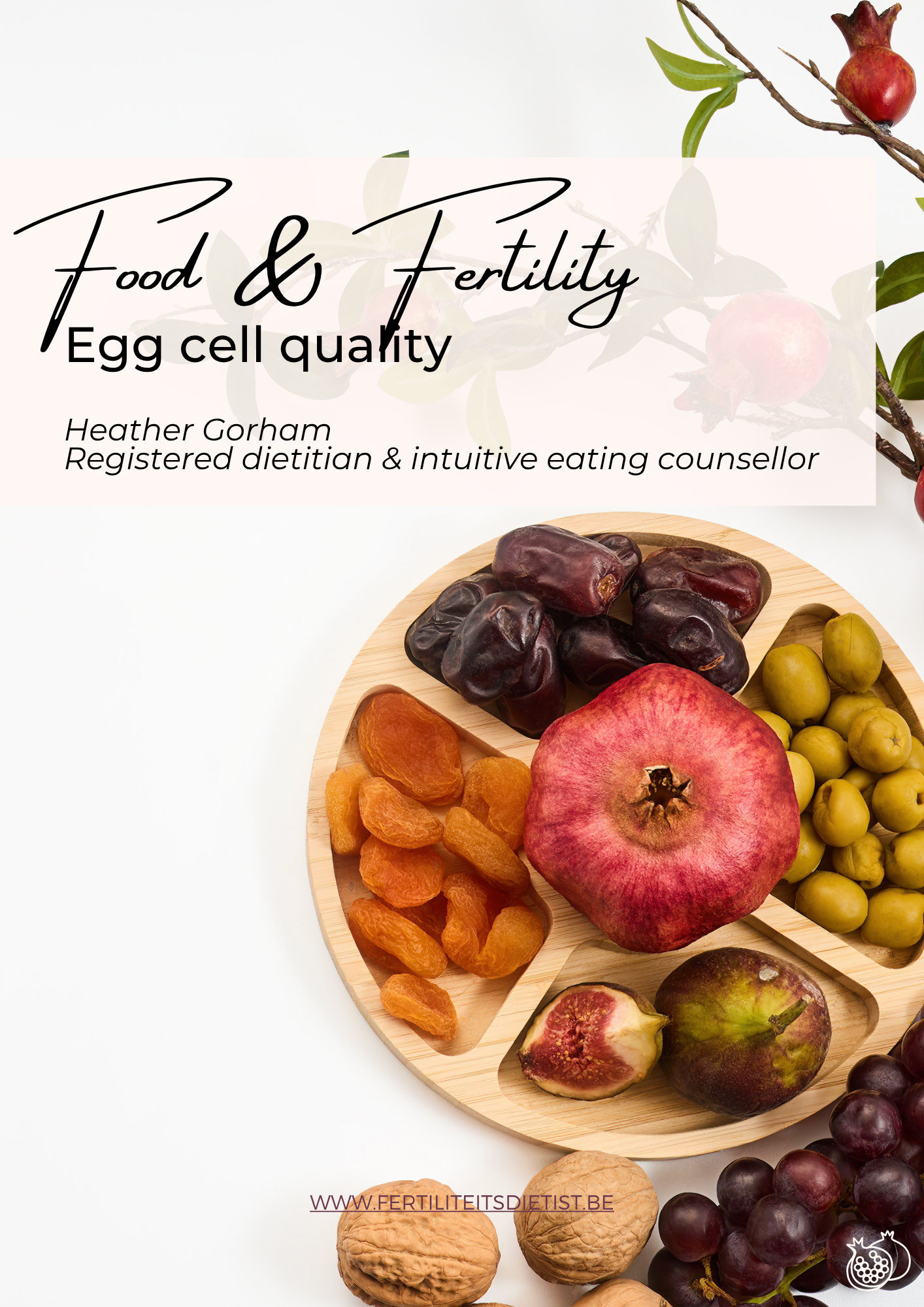
The Food & Fertility: Egg Cell Quality Guide
If you want a clear, evidence-based breakdown of exactly which nutrients matter, which supplements are worth considering, and how to translate all of it into what you actually eat day to day - that is what the Egg Cell Quality Guide covers in full.
A comprehensive, honest breakdown of how nutrition and lifestyle intersect with egg health. Written by a registered dietitian, grounded in research, and free of gimmicks. Available as an instant download.
A practical guide to support your egg quality
If you are navigating fertility challenges, there is a good chance you have already spent a lot of time searching for answers. Foods to add, things to cut out, supplements that might help. Every article leads to three more, and somewhere along the way the whole thing starts to feel like a part-time job, one that comes with a lot of anxiety and very little clarity.
That is a completely understandable place to be. The fertility nutrition space is genuinely overwhelming. A lot of what's out there is either too vague to be useful, too restrictive to be sustainable, or built on claims the evidence doesn't actually support.
This guide was written to give you something different. Clear, honest, research-backed information about how nutrition and lifestyle intersect with egg quality, so you can make informed decisions without the mental spiral.